
Do Fine Line Tattoos Fade? An Honest Answer After Nearly a Decade of Tattooing
- 42 minutes ago
- 5 min read
"I've heard fine line tattoos disappear after a few years."
She had barely sat down for her consultation before she said it.
It wasn't the first time I'd heard that sentence. In fact, I hear some version of it almost every week. Usually it comes from clients who have already consulted one or two tattoo artists before finding me.
"They told me the lines should be thicker."
"They said fine line tattoos don't last."
"Won't it disappear?"
By the time they arrive, they're almost expecting me to confirm everything they've already been told.
Instead, I ask them a question.
Would You Rather?
Imagine you had two choices.
In the first, your tattoo is designed with finer, carefully considered line weights. Seven or ten years from now it has softened ever so slightly, just as every tattoo eventually does. The composition is still elegant, the details remain readable, and if you ever wished to restore some of that original crispness, we could simply refresh it with a touch-up.
In the second, we make every line thicker from the very beginning because we're afraid it might fade. Ten years later, those already-bold lines have naturally softened and expanded as your skin has changed. Details begin to merge, the tattoo feels visually heavier than it once did, and there is nothing I can do to make those lines fine again.
That's the fundamental difference between the two approaches. I can always add ink. I can always make a tattoo darker. What I cannot do is selectively remove ink to recover the delicacy that was sacrificed in the beginning.
That simple reality shapes almost every design decision I make.
But the truth is, this conversation isn't really about fine line tattoos.
It's about decision-making.
One of the strange things about being a tattoo artist is that I'm constantly making decisions that will outlive the conversation we're having. A client might spend six months thinking about getting a tattoo, but I'll spend the consultation thinking about something entirely different. I'm thinking about the version of that person I'll never meet—the one who's forty-five, sixty or seventy years old. The tattoo I'm about to create belongs to them just as much as it belongs to the person sitting in front of me today.
Fresh Tattoos Are Temporary. Healed Tattoos Are Permanent.
Most people assume the goal of tattooing is to make a tattoo look as bold and crisp as possible on the day they leave the studio. It's an understandable assumption because fresh tattoos are what we see most often online. They're photographed under perfect lighting, freshly cleaned, glistening with ointment and at their highest possible contrast.
But those photographs represent only a fleeting moment in the tattoo's life.
The goal isn't to preserve a tattoo exactly as it looked on the day it was finished. That's impossible. The goal is something much more human. It's to create a tattoo that continues to feel like it belongs to you as both you and your skin change over time.
My job isn't to create something that looks spectacular under studio lights. It's to create something that still feels elegant, intentional and balanced when you're fifty-five. Once you begin thinking that way, every design decision changes. Spacing matters more. Scale matters more. Line weight matters more. The tattoo stops being something designed for today and becomes something designed for a lifetime.
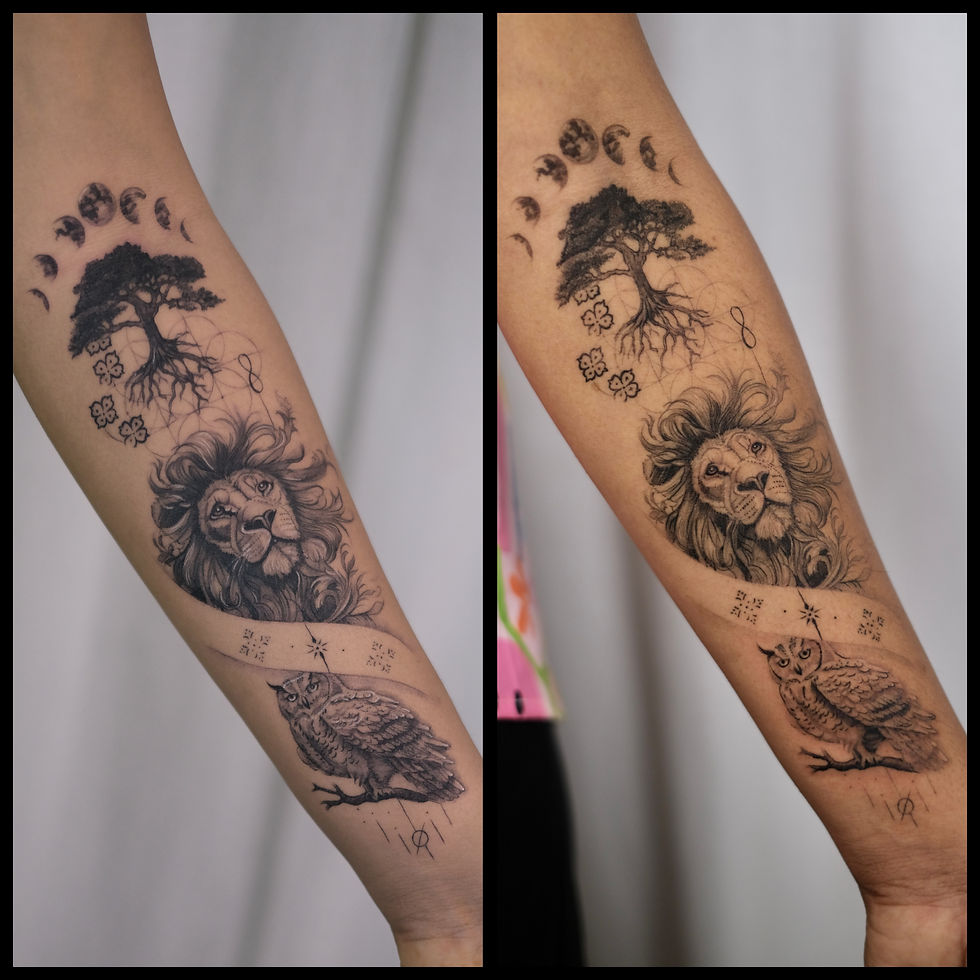
Skin Is Alive. That's the Point.
Long before I became a tattoo artist, my training in dentistry taught me something fundamental about the human body: living tissue is never static.
Skin isn't paper. It's a living organ that is constantly remodelling itself. Collagen changes throughout our lives. Elasticity changes. Even the way light travels through the skin changes as we age. Tattoo ink isn't suddenly disappearing after five years. More often than not, it's the skin surrounding that ink that has gradually evolved.
Permanence is one of the great illusions in tattooing. We call tattoos permanent because they stay with us, but nothing about the body is truly permanent. Skin changes. We change. Our relationship with our bodies changes. A tattoo isn't frozen in time. It grows older with us. The best tattoos don't resist that process. They embrace it.
That's why every tattoo ages. Traditional tattoos age. Japanese tattoos age. Realism ages. Fine line tattoos age. No style is exempt from biology.
The real question isn't whether your tattoo will change.
It's whether it was thoughtfully designed to change well.
Designing for Decades
This philosophy is something I think of as Designing for Decades.
Before I think about how your tattoo will look next week, I ask myself a much more important question: How should this tattoo look twenty years from now?
That single question influences almost every decision I make. Sometimes it means simplifying details that would eventually blur together. Sometimes it means increasing the breathing room between delicate elements. Sometimes it means recommending a slightly larger size than the client originally imagined. And occasionally, it means refusing to tattoo a design at a size that I know won't age gracefully.
Those conversations can be disappointing in the moment, but they come from the same place every time. Good tattoo design isn't about giving someone exactly what they've asked for. It's about giving them something they'll still be proud to wear decades later.
Time Is My Toughest Critic
One of the privileges of tattooing for nearly a decade is that I get to see my own work come back through the door. Clients return for new tattoos, and I inevitably catch myself looking at the older ones first. Not because I'm judging them, but because they're my teachers. Every healed tattoo tells me whether the decisions I made years ago were the right ones.
Every healed tattoo is a report card.
I don't get to decide whether my work has aged well.
Time does.
That's why I find healed photographs far more interesting than fresh ones. Fresh tattoos show what I can do in an afternoon. Healed tattoos show whether I made the right decisions.
So... Do Fine Line Tattoos Fade?
Yes.
Fine line tattoos fade.
Traditional tattoos fade.
Realism fades.
Every tattoo softens. Every tattoo changes.
The better question is whether it was designed with the future in mind.
If fine line tattoos truly disappeared after a few years, I would have changed my style long ago. I certainly wouldn't continue recommending them to clients I hope to see again years down the line.
My confidence doesn't come from marketing or from fresh tattoo photographs on Instagram. It comes from watching my own work heal, seeing clients return years later, and knowing that, given the very same canvas today, I would still make the same design decisions.
Because I don't design tattoos for today.
I design them for decades.


Comments